

Abstract
The research of this article aims to identify the values contained in the understanding of Sikep Sedulur Samin in Klopoduwur Village, Blora Regency, Central Java. In this study the method used is qualitative research methods using a phenomenological approach. And data analysis techniques using descriptive techniques. The method of writing in this article is by conducting reviews of various scientific journals related to Sikep understanding and conducting direct interviews with sources. The results of this article present a discussion topic regarding the values contained in the concept of self-understanding and the specialties of the Samin Indigenous People compared to other communities. In Paham Sikep itself contains values such as the value of divinity, the value of love for the country, the value of humanity, the value of honesty, the value of courtesy, and the value of love for the universe. Sedulur Sikep Samin maintains the relationship between the sedulur by showing social behavior such as the closeness between the sedulur, togetherness between the sedulur, and harmoniously helping each other. And the values of Paham Sikep itself which bring benefits to the life of the Samin Indigenous People who continue to maintain cultural continuity in the midst of modernization today.
Keywords: Samin’s Traditions, The Understanding of Sikep, Indigenous Psychology
PRELIMINARY
Indonesia has various kinds of diversity that have been considered well by the foreign world ranging from culture, language, religion, ethnicity, as well as flora and fauna. Not only those, the very strategic geographical location is also very beneficial for the Indonesian people to be proud of. The existence of a multicultural society further strengthens the Indonesian nation with the proud motto, namely Bhinneka Tunggal Ika. Of the many cultures and customs that exist, which are scattered throughout the archipelago, it must be familiar to the Samin custom which is closely related to Sikep. The Samin tradition itself is located in Klopoduwur Village, Banjarejo District, Blora Regency, Central Java.
The local wisdom of Sikep Sedulur Samin has been designated as Indonesian Cultural Heritage by the Ministry of Education and Culture. The people of Klopoduwur, Blora district, Central Java, are known as adherents of the teachings of Saminism. The Samin people resisted Dutch colonialism as proof of their love for their homeland. Samin resistance during the Dutch East Indies period was not physical but with an attitude that the Dutch Government considered as a deviant attitude, did not show behavior to support the Dutch Government so that the Dutch Government called the people of Samin as a crazy group because they did not obey the Dutch Government. Sikep teachings are teachings of nobility by prioritizing the arrangement of the heart that has a good impact on the survival of the Samin Community. The Samin people live not for material wealth but for inner wealth. The religion of the Samin Community is Islam and not a tribe or belief that does not know God. Even the Samin tribe highly values spirituality.
In the midst of the current modernization era which relies too much on technological sophistication, the Samin community still upholds existing traditions without neglecting the world’s life that continues to experience changes or globalization. Where certainly modernization has a good or bad impact, especially with something related to tradition, culture, or an understanding. From this, the researcher focuses on the impact and values contained in the sikep understanding adopted by the Samin community in the midst of the current modernization period, especially in the study of ulayat psychology itself.
RESEARCH METHODS
This study uses a qualitative method using a phenomenological approach. This study also used an interview instrument with four sources as participants. The characteristics of the participants of this study are knowing the behavior and teachings of Sikep sedulur Samin Blora, domiciled in the Klopoduwur area of Blora, and are willing to be an informant or resource person. Research design in this study uses descriptive, where the descriptive has a clear statement of the information available. The population in this study was the entire Samin Indigenous community who adhered to the teachings of sikep and the sample in this study amounted to 4 resource persons who had the following criteria
a. Knowing the teachings of Sedulur Samin
b. Domiciled in the Klopoduwur area, Blora
c. Willing to be an informant or resource person
RESULTS AND DISCUSSION
Humans are social creatures who are born with different personalities and traits and have an invisible soul but can be seen in certain situations. Different personalities and traits make different kinds of behavior. According to Sutarlinah and Sukadji, psychology is the study of human behavior in the processes associated with these processes. Indigenous psychology is a scientific study of genuine human behavior, which is not adapted from other areas designed by the community. Human behavior is influenced by customs, attitudes, emotions, values, ethics, power, persuasion and ethical genes.
The principle that the Samin tribe holds is Sedulur Sikep Samin maintains the relationship between each others by showing social behavior such as closeness, togetherness, and getting along harmoniously to help each other. The Samin tribe never offend anyone, because they think that life in this world only has relatives, so don’t offend other people (relatives). This kind of behavior is based on the belief that every human being is a brother to other humans (Mujib, 2009).
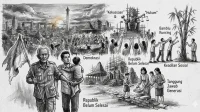
According to Toer (2001) the Samin tribe’s opposition to the Dutch government is reflected in the Samin tribe’s sayings about equality, namely that land and crops are the common property of mankind, and the Dutch have no right to take taxes on the results of the land and water. The Samin tribe considered the Dutch colonials as an outsider and did not have the right to control their land, this resulted in their opposition to the Dutch colonial government.
According to Jalaluddin (2016) if a person already knows what is the purpose of his life, it will be easier to interpret life, so that every action, behavior, and speech reflects how he interprets his chosen life goal. This is like what Sikep Samin’s brother did with two kinds of attitudes that are firmly held, namely Panca Sesanti and Panca Welaler. According to Carr (2004) there are two aspects of happiness, namely affective and cognitive. The affective aspect represents the emotional and the cognitive aspect represents the cognitive evaluation. By holding fast to Panca Sesanti and Panca Welaler, the Samin tribe feels a happy, calm and peaceful life with harmony which has a positive impact on their psyche and mental health. Zakiyah Daradjat in his book (Religious education in mental development, 1982) which summarizes the definitions of several experts says that mental health is the avoidance of a person from the symptoms of mental disorders and diseases, being able to adapt, being able to take advantage of all the potential and talents that exist as much as possible and bring to happiness together and achieve harmony of a living soul.
The Samin tribe is not a tribe that does not know God and the Samin tribe is not a follower of communism. Sikep’s teachings have a high spiritual value and are interconnected, both the relationship between humans and God, the relationship between humans and humans, and the relationship between humans and the universe. The Samin tribe never discriminates against humans. Rich or poor, low or high rank all the same. Gumiandari (2012) humans have a spirit or spiritual element in addition to their body and soul. The Samin tribe believes that when someone dies, what is lost is the body, and the spirit is still there.
In the Samin community itself, parents who adhere to the Sikep teaching always instill moral values in their children by using an example approach or model of good behavior. harmony, the value of courtesy, the value of discipline, and the value of cooperation that have been carried out well. In this case, several parties play a role between the family and the surrounding environment.
According to the Samin community, the most important thing is that they do not disturb other communities and vice versa, the Samin community does not want to be disturbed by other communities by disrupting the life and social institutions of the community as well as disturbing the dynamics of life that exists in the Samin community itself. And also the Samin community can still accept the presence of popular culture and the development of information technology today. But the Samin community still maintains the purity of Sedulur Sikep’s teachings.
In this study, we’ve interviewed four sources the elders of Sedulur Sikep . The first source is Mbah Lasiyo (64years), who is descendant of samin suro angkrek and also the elders of Sedulur. “Many people don’t know about samin, Sikep Samin was introduced by 3 characters, namely Suro Sumanto (Bali), Suro Ngkrik (Klopoduwur Blora), and Suro Sentiko (Randu Papangan). Samin wasn’t a crazy, it’s just that his behavior is different in taking action against the Dutch government, so the Dutch government is furious and branded the Samin tribe as crazy. He isn’t a PKI (Indonesian Communist) either, It’s just Sedulur Sikep has an attitude of living alone by prioritizing cleanliness of heart and live in harmony surround them. There are two kinds of life attitudes that are always held, namely Panca Sesanti sikep Samin (five life mottos) and Panca Wewaler (five rules of life).
Included in Panca Sesanti attitude are ora seneng memungsuhan, ora seneng rewang kang dudu sakmestine, ojo ngrenan liyan, laneling sing kuwoso. And Panca Waweler are, pepadange urip, ora nerak welarane negara ora nerak sing dudu sakmestine, ora cidro ing janji, ora sepoto nyepatani.
The Samin people is a cultural phenomenon with a legacy of high cultural value, which qualifies for a message in every teaching. The Samin people are known as innocent but very critical. The attitude of Samin society people is known to be very simple and very honest, so many people call them very innocent because of their extreme individuality and self-interest in the present era. Phenomenon of the Samin people existence with all their very unique attitude and habits and also sincerity has made a lot of people interested researching to them. Not only javanese, but various regions in Indonesia to do research in droves.
The second source is Mbah Wahini (60 years old) who is also a native of the samin tribe and also as responsible person of the Pendopo Sedulur Sikep Samin, Klopoduwur, Banjarejo district of Blora.” Sedulur Sikep has many traditions related to religion, such as Friday night prayers and Tuesday nights at 12 o ‘clock that are symbolized as water. Water flowing as pitunjuk, pitutur, lan pitulung. Sedulur Sikep upholds the religious value (Allah) and relies on all of nature.”
Facing a phenomenon that is occurring in samin communities we may need to learn from past centuries about the history of the guardians of Java and places, the guardians integrated Islam and culture in a organized and effective way as part of the strategy. Many consider the people of samin to be neither islamic nor just islamic identity. In fact samin society is Muslim and highly values the value of deity. Even the former residence of one of siphri’s or commonly called samin is now a mosque of which samin society can benefit and serve in clopoduwur, the district of blora.
The third source is Mr Sutarno (48 years old), a local community in the village of Klopoduwur. “Siphoners value others highly, especially guests. Siree if a guest appears courteously, we will treat them with more courtesy, and if a guest comes to us impartially don’t expect us to be kind to them. We were born as social beings, connected to one another all the time. So are the people of samin, though many labels from the outside world, but the samin are also social-related beings. The people of samin are very protective of the feelings of others or guests. This is because it can get good feedback, because the samin people prefer peace and a quiet life with no problems with others and deeply respect others.
There is even one of the hadiths that speaks of glorifying a guest as “whosoever has faith in god and the last day let him glorify his guest” (h.r. Bukhari.) We can understand together that the samin community is highly upholding the positive values the ancestors have taught for good habits or good habits. This made the Dutch government very angry and wanted to get rid of the samin because the samin refused to comply with his rule, because the Dutch government only concerned them, especially farmer.”
The fourth source is early damayanti (18 years), the local village of Klopoduwur. “Siphoning is a very simple person, and the majority work as farmers. Not all the sedulur sicker received an education, but they were very aware of manners and acted out of courtesy to sesame living creatures. The samin man must understand his life, for man has one immortal spirit, dying is only a body, but not for the spirit.”
Sedulur Sikep behavior is very different from that of other societies, if not more so than in a sense. Starting with his teaching, even his thinking was very different from that of other people.
Sedulur Sikep has an extremely rich behavior of generosity and is not envious. Samin people’s honesty can be an example to be a better person. In addition, the religious aspect is strong though there is a mixture of the teachings of sicassia.
From the people of samin we can learn that life is not only about worldly gratification, but it must be filled with a conscience that will make us think that everything is not only about the world, but also the next. We in the world must do well to receive blessings and provisions for the afterlife.
The conclusion of our interview was that 3 persons introduced the teachings of Sikep Samin, namely Suro Sumanto (Bali), Suro Ngkrik (Klopoduwur Blora), and Suro Sentiko (Randu Bapangan) that spread across Java even beyond Java. Many have believed that the samin character is suro sentiko but that there are actually 3 characters in the propagation of cyline teachings. They have different ways of fighting the Dutch colonization. The people of samin, more commonly known as siphoners, have a religion of Islam, even upholding the high value of spirituality. They have a culture or tradition that must be preserved, but they always add an element of spirituality to every tradition. Samin’s people also appreciate and respect each other and are no exception to their new acquaintances or visiting guests.
From the people of samin we can learn that life is not only about worldly gratification, but it must be filled with a conscience that will make us think that everything is not only about the world, but also the next. We in the world must do well to receive blessings and provisions for the afterlife.
In this we can talk together that the samin people have a good defense or a good defence mechanism in aligning aspects of their lives so that social dynamics can go well and have a positive impact on everyone. Self-defense or def mechanisms.
CONCLUSION
The Sikep has considerable influence or effect on its followers. Where there are various decent values implemented in everyday life. For future use of life to be achieved. In the application of independent wisdom, the riches of the heart outweigh the riches of material possessions. For the moment of death that will be remembered is a good image of his conduct or deeds. Especially in the vastly different times in which these teachings of siphoners have surely benefited and benefited from today’s highly dynamic lives.